
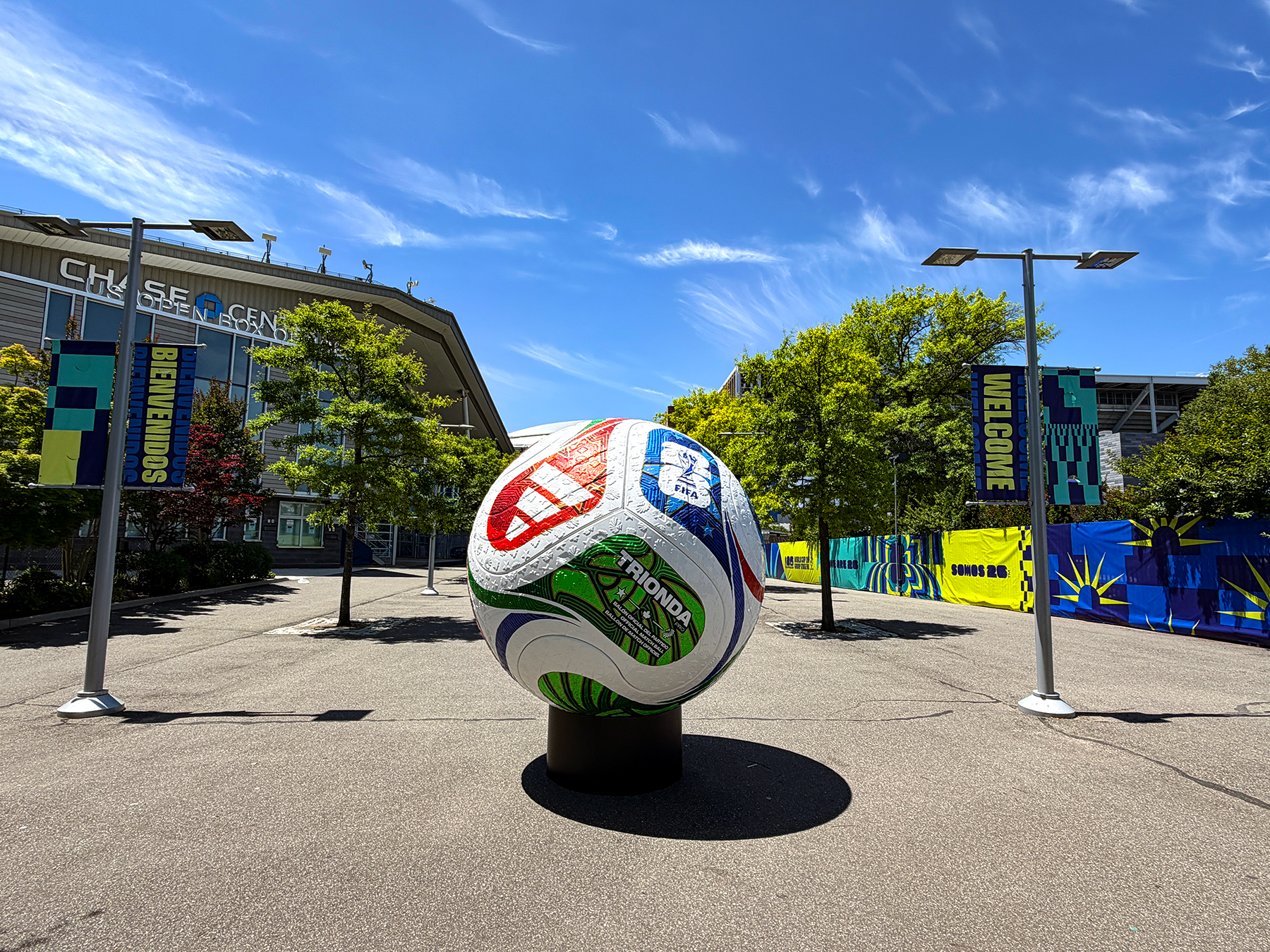
Custom World Cup branding at the Queens Group Stage HQ, USTA Billie Jean King National Tennis Center
TL;DR: The 2026 World Cup proved that most fans experience a tournament outside the stadium. Official fan festivals drew record crowds, and the brands that did well treated fan zones as live production problems first and marketing opportunities second. Know your crowd's rhythm, design for the slow hours as well as the full ones, and build branding that holds up for weeks instead of a day.
The final whistle blew on July 19 in New Jersey, and the numbers came out soon after. More than 9,017,000 people attended the FIFA Fan Festival across 13 Host Cities, the highest figure since 2006. Roughly seven million spectators attended matches in stadiums, which means more people watched this World Cup in a park or public square than in a seat.
That changes how brands should think about tournament marketing. Here's what the summer showed us, including from our own work on two fan zone projects for the New York New Jersey World Cup 26 Host Committee.
The crowd doesn't arrive evenly
Fan zone traffic follows the match schedule, and the schedule is brutal on planners. The biggest single day came on 27 June, when 543,020 people visited festival venues on the final day of group-stage games. Other days were a fraction of that.
The local numbers tell the same story. Houston's five biggest fan festival days ranged from about 20,800 to 24,400 visitors, and those peaks sat next to much quieter weekday afternoons.
For a brand, this means one activation footprint has to work at two very different scales. A sampling station sized for a Saturday knockout game will feel empty at noon on a Tuesday. A photo moment that's pleasant at half capacity can become a crowd control issue when a home nation scores.
The practical lesson: plan your staffing, inventory and queue design around the match calendar, not a flat daily average. Identify your peak days the moment the schedule is confirmed, and decide in advance what changes when they arrive.
Duration is a design brief of its own
Most brand activations run a weekend. Fan zones ran for weeks. The 13 festival locations operated for a combined 348 days, almost 3,200 hours, across the tournament's 39 days.
That length stresses everything. Vinyl fades and peels. Flooring wears through. Touchscreens fail in heat. Staff burn out. A build that looks sharp on opening day can look tired by the quarterfinals, and by then it's on camera more than ever.
Our work in Queens is a good example of planning for duration. For the Host Committee's Queens Group Stage HQ, produced for Live Nation, IDEKO delivered more than 20,000 square feet of custom branding at the USTA Billie Jean King National Tennis Center. The site ran for a month of live screenings, cultural programming and performances, including Busta Rhymes and Los Rabanes, with multiple match days welcoming 10,000 attendees. You can see the full Queens HQ signage project here.
Branding at that scale for that long has to be specified for the environment: material choices that survive sun and rain, installation that crews can maintain, and graphics that still read from across a packed lawn on the last night.
Short runs reward tight operations
The opposite case teaches just as much. A two-day fan zone has no room to fix mistakes on day three.
IDEKO was the lead production partner for the Host Committee's Bronx Fan Zone at Bronx Terminal Market. Over two days, the site offered live match viewing, family activations, local food vendors and cultural programming. Our team handled site operations, ticketing, logistics, fabrication, branding, technical production and event execution. The Bronx Fan Zone project page has the details.
When one partner owns that full list, the hand-offs disappear. Ticketing talks to site ops. Fabrication knows where the power runs. On a short event, that's the difference between a smooth opening and an hour of fixing things in front of the first guests.
Local identity beat generic branding
FIFA's own review made a point of it: local artists, cultural groups, DJs and community performers gave each festival a distinctive identity that reflected its host city.
Brands that dropped the same activation into every market missed this. Fans in the Bronx, Queens, Houston and Mexico City didn't want the same thing. The Bronx Fan Zone worked because it was built around the borough itself, with local food and cultural programming next to the screens.
If you're activating across several markets, keep a consistent core and let each site carry local character. That might mean regional food partners, neighborhood artists, or programming in the languages your crowd actually speaks.
The content traveled further than the crowd
Fan zones were built for people on site, but the reach went well past the fences. Content from festival sites drew a cumulative 811 million video views across 200 posts on FIFA's tournament channels.
That's a reminder to design every activation for two audiences: the fan in front of you and the person watching on a phone later. Sightlines for cameras, lighting that works after sunset, and a backdrop that reads at a glance all matter more than another interactive screen nobody remembers.
A simple giveaway can carry a lot of weight
Bank of America distributed 2 million Fan Bands across the tournament, with festival sites as the main hub, and fans queued to get one.
The takeaway isn't "give away wristbands." It's that a physical object tied to the moment gives fans a reason to visit your space and something to keep afterward. It also creates a queue, so plan for one.
What to carry into the next tentpole event
The World Cup is over, but the lessons apply to any large, long, public event, whether that's a championship run, a city festival or the LA 2028 Games.
Plan to the schedule. Map your peaks to the event calendar and staff for them specifically.
Spec for the full run. Materials, maintenance and crew rotation need to be built for week four, not day one.
Own the operations. Fewer hand-offs between ticketing, logistics, fabrication and production means fewer failures in public.
Go local. A consistent brand core with local programming outperforms a copy-paste build.
Build for the camera. The on-site crowd is only part of your audience.